“My father, who had been a horse trader in Russia, got himself a horse and a small wagon, and became a ragman, buying old rags, pieces of metal, and junk for pennies, nickels, and dimes… Even on Eagle Street, in the poorest section of town, where all the families were struggling, the ragman was on the lowest rung on the ladder. And I was the ragman’s son.”
In 1953, a new presidential administration took office in the United States. With the transition from Harry Truman to Dwight Eisenhower, U.S. foreign policy began to shift, distancing itself from Israel to pursue a more evenhanded approach to the Arab-Israeli conflict.
That same year, United Nations journalist David Horowitz was in Israel serving as a Special Correspondent for The Voice, a Los Angeles publication with the largest Jewish circulation in the western United States. He had been sent to write a special report on the progress of the young State of Israel as it learned to live a new life of self-determination.
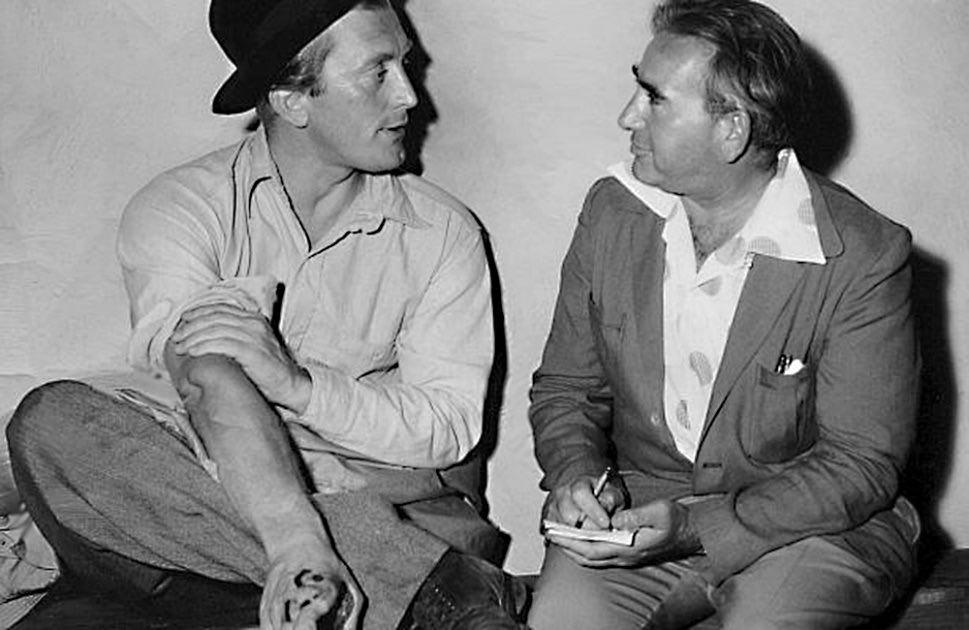
At the very same time, a young, U.S.born actor—the son of Jewish immigrants from Russia—was also in Israel. He was there on location for the filming of The Juggler, a dramatic motion picture about a Holocaust survivor.
The actor had been born Issur Danielovitch in 1916 in Amsterdam, New York, to Herschel and Bryna Danielovitch. Raised in poverty alongside six sisters, he grew up in a struggling immigrant household. His father’s brother, who had emigrated earlier, had adopted the surname Demsky, a name the family later took in the United States. As a young man, Issur Danielovitch became known as Izzy Demsky.
Before entering the United States Navy during World War II, he would legally change his name for a third time. From that point on, he would be known by his stage name: Kirk Douglas.
Douglas made his film debut in 1946, costarring opposite Barbara Stanwyck in The Strange Love of Martha Ivers. Over the next several years, he appeared in sixteen additional films. In 1953, he took on the role of Hans Muller in The Juggler, which was filmed on location in Israel. It was not the first time Kirk Douglas and journalist David Horowitz found themselves in Israel at the same moment in history.
Douglas had already become an international star for his leading role as an unscrupulous boxing hero in Champion (1949), a performance that earned him his first Academy Award nomination for Best Actor. While in Israel, he met and was interviewed by Horowitz. The two men—both Jewish sons of immigrants—found much in common. Douglas spoke openly about his Jewish upbringing, revealing that Yiddish was the primary language spoken in his childhood home.
He recounted the hardships endured by his parents, his six sisters, and himself while growing up in Amsterdam, New York. As a boy, Douglas sold snacks to mill workers to earn enough money to buy milk and bread for his family. He later delivered newspapers, and by his own account held more than forty jobs before becoming an actor. Growing up in a household with six sisters felt stifling to him. As he once said, “I was dying to get out. In a sense, it lit a fire under me.”
After performing in plays during high school, Douglas knew he wanted to pursue acting professionally. Unable to afford college tuition, he talked his way into the dean’s office at St. Lawrence University, where he presented a list of his academic and extracurricular honors. The dean granted him a loan, which Douglas repaid by working parttime as both a gardener and a janitor. He also excelled as a member of the wrestling team and spent one summer wrestling at a carnival to earn additional money.
Douglas’s acting talent later caught the attention of the American Academy of Dramatic Arts in New York City, which awarded him a special scholarship. One of his classmates was Betty Joan Perske—later known to the world as Lauren Bacall—who would play a pivotal role in launching his film career. Bacall later admitted that she “had a wild crush on Kirk,” and the two dated casually. She ultimately recommended him to producer Hal B. Wallis, who was searching for new male talent. Wallis cast Douglas in The Strange Love of Martha Ivers (1946), starring Barbara Stanwyck, marking Douglas’s first appearance on the silver screen.
Over the course of a 64year acting career, Kirk Douglas appeared in more than ninety films. He received three Academy Award nominations and, in 1996, was honored with an Academy Honorary Award for fifty years as a creative and moral force in the motion picture industry. He was also nominated for or won four Golden Globe Awards, three Emmy Awards, an Oscar for lifetime achievement, and the Presidential Medal of Freedom.
Douglas often reflected on how fortunate he was to have lived long enough to accomplish so much. Had he not followed the advice of his wife, Anne Douglas, he would have been aboard producer Mike Todd’s private plane in 1958 when it crashed, killing everyone on board. Todd’s wife, Elizabeth Taylor, had also been scheduled to fly but canceled at the last moment due to a severe cold. Years later, in 1991, Douglas barely survived a helicopter crash.
Although best known as a film star, Kirk Douglas also built a distinguished literary career as the author of both fiction and nonfiction. He wrote ten novels and memoirs, including his bestselling autobiography, The Ragman’s Son (Simon & Schuster, 1988), from which the opening quote is taken.
Kirk Douglas passed away at the age of 103. A centenarian of cinema and one of the last living figures of Hollywood’s Golden Age, his life was the quintessential ragstosuccess story—rising from The Ragman’s Son to become a bona fide superstar.
Hollywood couldn’t have written a better script.